
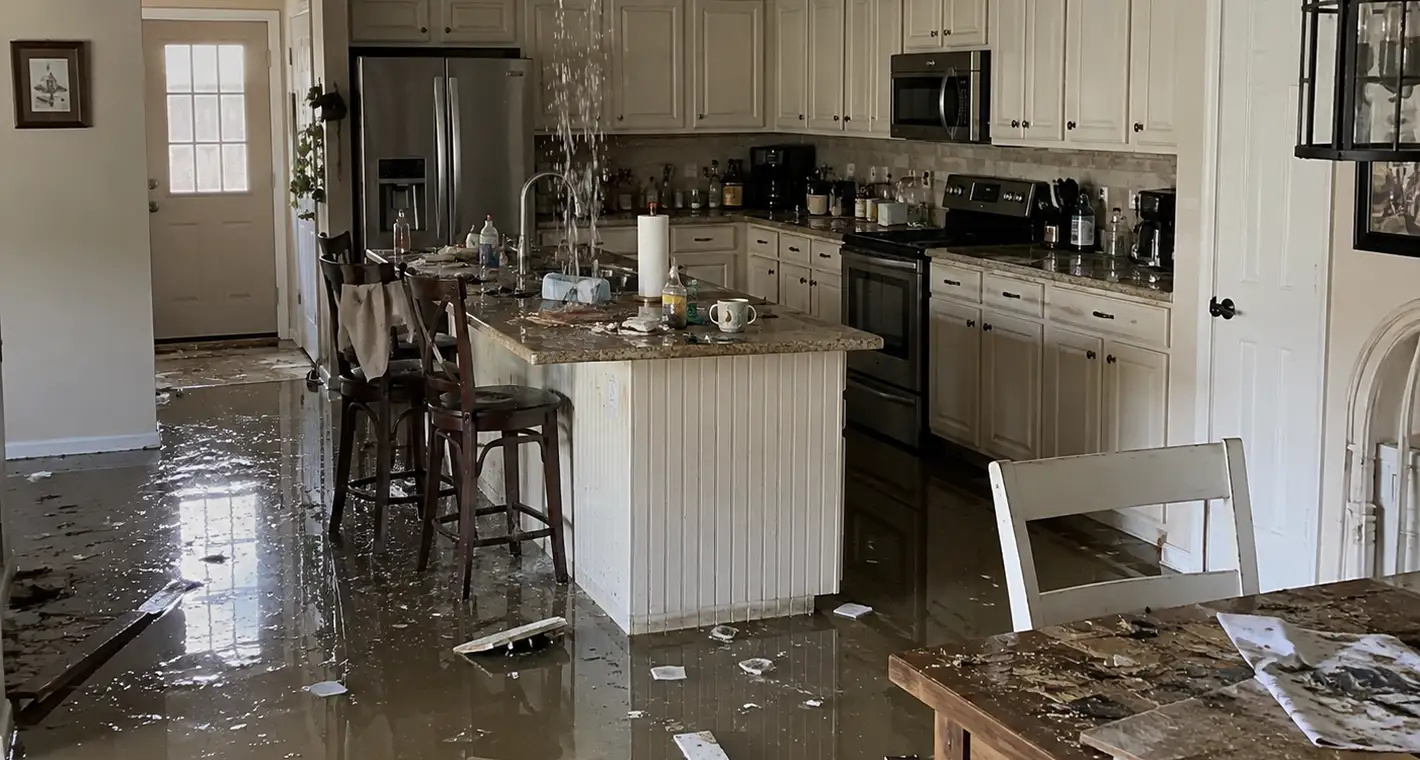
Water damage in Oak Park
Oak Park is built into the Simi Hills on the northern rim of the valley, an unincorporated pocket of southeastern Ventura County. It meets Thousand Oaks on the west and the Los Angeles County cities on the south, with open space north and east, and its slopes drain into the Medea Creek system. Development began in the late 1960s and continued in phases into the 2000s, almost entirely on graded hillside pads. Slab foundations throughout, with the slopes between the terraces held by association-maintained landscaping and drainage.
Those two facts shape most of the losses that happen in Oak Park. Where a house sits and what its plumbing was built for decide how water gets in and where it travels afterwards.
Before help arrives
- Shut the water off at the fixture or the main if you can reach it safely.
- Keep out of any room where water has reached outlets, cords, or the electrical panel.
- Lift furniture off wet carpet and move what you can to a dry floor.
- Photograph the damage and the failure point before anything is moved.
- Do not use a household vacuum to pick up standing water.
Common causes in Oak Park
The community the 2018 fire reached first
The Woolsey Fire started in the Simi Hills and Oak Park was the first community it reached, on the night of 8 November 2018. Homes were lost and slopes immediately above the terraces were stripped. Burned ground stops absorbing rain for several seasons, and on a community built in steps up a hillside each terrace then delivers water and sediment to the one below.
Terrace drains under mature landscaping
Hillside grading here relies on swales behind the houses and drains partway up each slope to intercept water before it reaches a pad. Thirty and forty years of planting, bark and settled soil bury them, and the failure is invisible until a heavy storm. When an intercept drain stops working, the water runs along the back wall of the house below.
Original copper in the earliest phases
Houses from the first phases have been on their original supply lines for five decades or more, and copper of that age under a slab develops pinholes rather than bursts. The water arrives slowly and underneath the floor, so it is found as a warm patch, a meter that keeps turning, or flooring that lifts at a seam.
Upper-floor plumbing in the later phases
The two-storey plans built from the 1990s onward put bathrooms and often the laundry above living space. A supply connector or a washing machine hose failing there releases under pressure into the floor assembly, and it spreads along joists before appearing anywhere. The ceiling below gives way after the cavity is already holding water.
Drying a Oak Park home
Because the community was built in phases over four decades, the same street pattern hides very different construction. The 1960s and 1970s houses carry original copper and single-storey plans that keep a loss at floor level; the phases from the 1990s onward are two-storey with plumbing upstairs. Which phase a house belongs to decides where you look for the water.
The sequence itself does not change from house to house: extraction first, then air movers and dehumidifiers working together, with moisture readings logged each day until the affected materials match the dry baseline for that building. It is described in full on the water extraction and drying page.
Services available in Oak Park
- Water Extraction & DryingStanding water removal and controlled structural drying under moisture readings.
- Slab Leak DamageWater surfacing through a slab-on-grade foundation, located and dried out.
- Sewage CleanupContaminated water handled with containment, removal and cleaning.
- Mold RemediationGrowth that established after water sat longer than it should have.
- Burst pipe and supply line cleanup
- Water heater and appliance leak cleanup
- Ceiling and drywall water damage
- Moisture inspection and mapping
Areas covered in Oak Park
Providers cover Oak Park and the surrounding area, including Oak Park North, Morrison Highlands, Deerhill, Oak Hills, Medea Valley and Kanan corridor.
ZIP codes: 91377.
Frequently Asked Questions
- Will my homeowners insurance cover water damage?
- It depends on the cause rather than the damage. Policies commonly cover sudden and accidental events such as a burst supply line or a failed water heater. Damage that developed gradually from a long-standing leak, and damage from surface flooding, are usually handled differently or excluded. Photograph everything before it is moved, keep any failed part, and report the loss promptly.
- Should I turn off the electricity?
- If water has reached outlets, cords, appliances or the panel itself, treat the area as unsafe. Shut off the breaker only if you can reach the panel without standing in water and without touching anything wet. If you cannot, leave the area and have the utility or an electrician handle it.
- The slope behind our house is maintained by the association. Whose problem is the drainage?
- It depends where the water is being intercepted, and it is worth establishing before a storm rather than during one. Association-maintained slopes usually include the terrace drains and swales on the common area, while drainage on the lot itself belongs to the owner. What matters for the house is that both are clear, because a working association drain feeding a blocked area drain still puts water against the wall.
- How do I tell whether water in the ceiling came from a pipe or from the roof?
- By whether it follows the weather. A roof or flashing leak appears during or shortly after rain and stops between storms, usually near a penetration such as a vent or a chimney. A supply line failure is steady and indifferent to the weather. A condensate line from an attic air handler splits the difference: it runs in cooling season and stops in winter.
- Insurance is involved. What should I keep and what should I throw out?
- Keep the failed part, whatever it is, and keep it dry: the connector, the hose, the section of pipe. Photograph every affected room before anything is moved, and photograph again as material is removed. Do not dispose of removed carpet, padding or drywall until the adjuster has seen it or agreed that photographs are enough.
- Oak Park is in Ventura County but the cities along its southern edge are in Los Angeles County. Does that affect getting someone out?
- Not in practice. The corridor works as one service area, and providers covering Agoura Hills and Westlake Village reach Oak Park on the same runs regardless of which county line they cross. Where the county does come into it is administrative: permits and inspections for structural repairs go through Ventura County rather than the neighbouring jurisdictions, which matters once a repair moves beyond drying into rebuilding.