
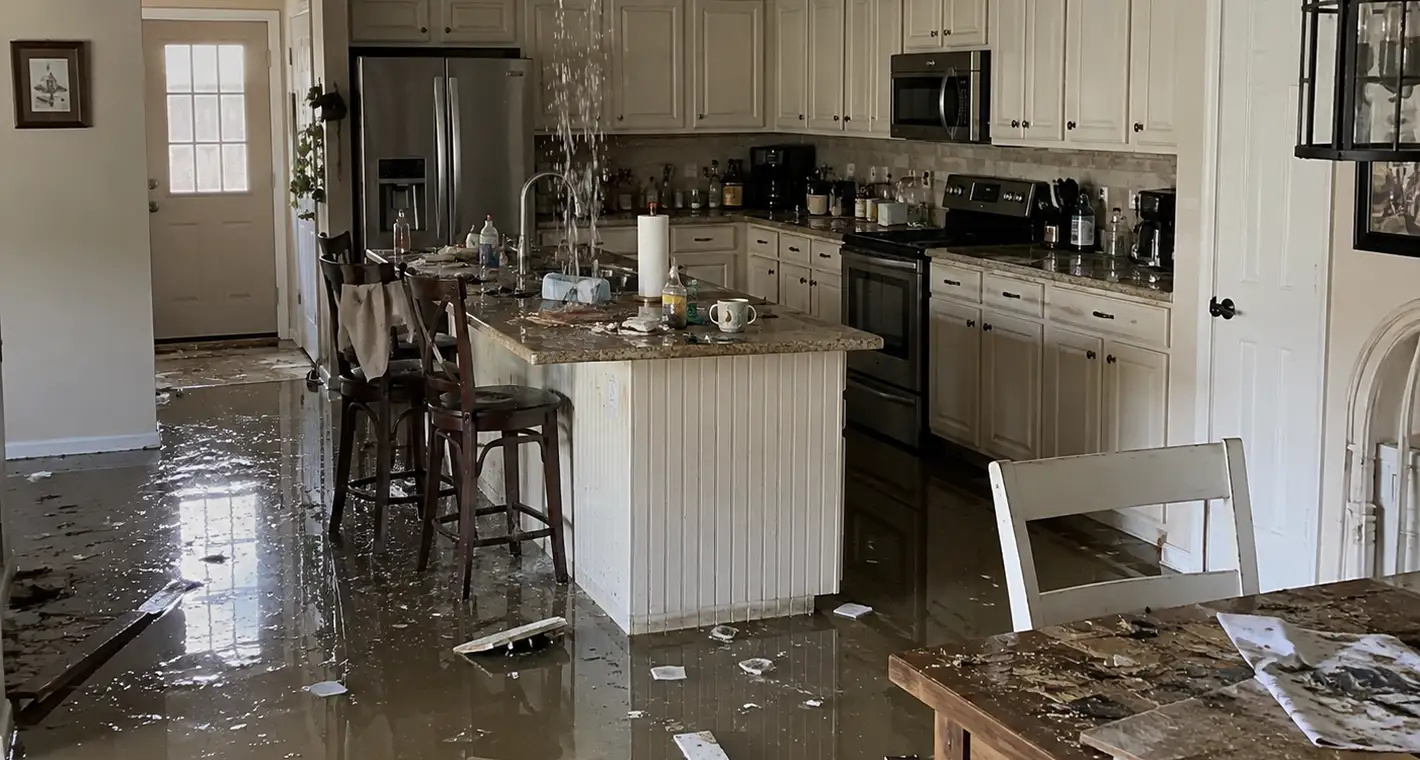
Water damage in Calabasas
Calabasas sits at the eastern end of the corridor, where the Conejo Valley runs out into the canyons of the Santa Monica Mountains. Las Virgenes Creek drains south toward Malibu Creek, and the chaparral ridges on both sides are the ones that carry fire. Two kinds of building stock: the older fabric along Calabasas Road in the original town, and gated hillside tracts from the 1980s through the 2000s, largely two-storey stucco on slab on pads graded out of the slope.
Those two facts shape most of the losses that happen in Calabasas. Where a house sits and what its plumbing was built for decide how water gets in and where it travels afterwards.
Before help arrives
- Shut the water off at the fixture or the main if you can reach it safely.
- Keep out of any room where water has reached outlets, cords, or the electrical panel.
- Lift furniture off wet carpet and move what you can to a dry floor.
- Photograph the damage and the failure point before anything is moved.
- Do not use a household vacuum to pick up standing water.
Common causes in Calabasas
Canyons that burned in 2018
The Woolsey Fire crossed roughly thirty-nine thousand hectares in November 2018, running from the Simi Hills across this corridor to the coast. Slopes above the canyon roads lost their cover, and burned ground sheds water rather than taking it in. In the wet seasons that follow, runoff comes down faster and carries soil, reaching properties at the foot of a canyon as mud rather than rain.
Laundries and bathrooms on the upper floor
Newer construction here puts the laundry upstairs, often above an open ground floor with no wall to interrupt the ceiling. A braided supply hose behind a washing machine has a service life, and when it lets go on an upper floor it releases under full pressure until someone is home to find it. The ceiling below usually fails after the cavity above it is already saturated.
Pads graded out of the slope
Hillside lots depend on a system that becomes invisible once the landscaping matures: a swale behind the house, terrace drains on the bank above, and area drains carrying it all to the street. Roots and settled soil fill them. Once they stop working, storm water runs along the uphill wall instead of around it, and on slab construction that puts it at the level of the sill plate.
Creek crossings and canyon runoff
Las Virgenes Creek and the drainages feeding it run dry most of the year and carry a great deal of water in a short time when a storm sits over the mountains. Properties near a crossing see the level rise faster than rainfall alone would suggest, because the whole canyon above contributes at once, and it arrives with debris in it.
Drying a Calabasas home
The two-storey plans that dominate the newer tracts change where a loss ends up. A supply line or a bathroom upstairs sends water into the floor assembly, and it runs along joists and ductwork before it comes through the ceiling of a room at the other end of the house. By then that cavity has been holding water for a while.
The sequence itself does not change from house to house: extraction first, then air movers and dehumidifiers working together, with moisture readings logged each day until the affected materials match the dry baseline for that building. It is described in full on the water extraction and drying page.
Services available in Calabasas
- Water Extraction & DryingStanding water removal and controlled structural drying under moisture readings.
- Slab Leak DamageWater surfacing through a slab-on-grade foundation, located and dried out.
- Sewage CleanupContaminated water handled with containment, removal and cleaning.
- Mold RemediationGrowth that established after water sat longer than it should have.
- Burst pipe and supply line cleanup
- Water heater and appliance leak cleanup
- Ceiling and drywall water damage
- Moisture inspection and mapping
Areas covered in Calabasas
Providers cover Calabasas and the surrounding area, including Old Town Calabasas, Calabasas Hills, The Oaks, Mountain View Estates, Calabasas Highlands and Mulholland corridor.
ZIP codes: 91302.
Frequently Asked Questions
- Will my homeowners insurance cover water damage?
- It depends on the cause rather than the damage. Policies commonly cover sudden and accidental events such as a burst supply line or a failed water heater. Damage that developed gradually from a long-standing leak, and damage from surface flooding, are usually handled differently or excluded. Photograph everything before it is moved, keep any failed part, and report the loss promptly.
- Should I turn off the electricity?
- If water has reached outlets, cords, appliances or the panel itself, treat the area as unsafe. Shut off the breaker only if you can reach the panel without standing in water and without touching anything wet. If you cannot, leave the area and have the utility or an electrician handle it.
- We are downhill of a slope that burned. Does that still matter years later?
- It matters less each year but not immediately. Vegetation takes several seasons to re-establish, and until it does the burned ground repels water instead of absorbing it, so runoff is faster and carries soil. What reaches a property at the foot of a canyon is a mix of water, ash and sediment, and it behaves differently from rain: it blocks the drains meant to handle it and leaves material behind inside the structure.
- How long can a leak inside a wall go unnoticed here?
- Longer than most people expect, particularly a supply line rather than a drain. A pinhole releasing under pressure into a stud bay wets framing, insulation and the back of the drywall while the painted face looks normal, and the smell usually arrives before any visible mark. Warm spots, a rise in the water bill and paint lifting at a seam are the practical signs.
- Do I need to leave the house while it is being dried?
- Usually not. Drying equipment is loud but runs safely with people in the house, and most losses affect part of a home rather than all of it. The situations that argue for staying elsewhere are contaminated water in living space, damage involving the electrical system, or remediation that requires sealing off a large section of the floor plan.
- A ceiling downstairs is stained but nothing upstairs looks wet. How does that happen?
- It is the normal sequence in a two-storey house. Water released on the upper floor goes into the floor assembly beneath it, travels along joists and around ductwork, and comes through wherever the ceiling below is weakest, often a light fitting or a seam. The floor above can look dry because its covering shed the water into the gaps at the edges. The wet area is in the cavity between the two.