
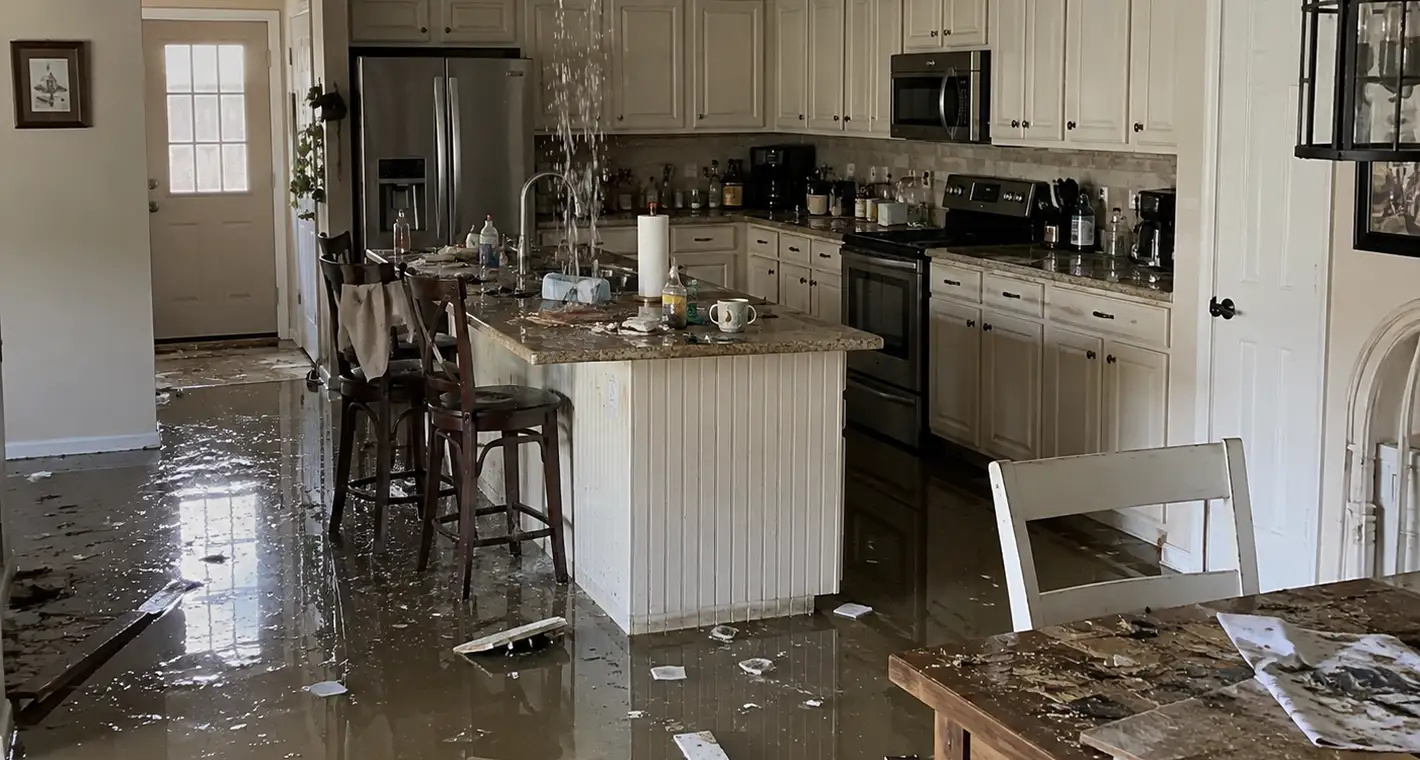
Water damage in Santa Rosa Valley
Santa Rosa Valley is the next valley north over the ridge from Thousand Oaks, drained by Arroyo Santa Rosa toward Conejo Creek. Around a quarter of the Arroyo Conejo watershed lies on this side, and the Hill Fire of November 2018 began where Hill Canyon meets Santa Rosa Road. Estate and ranch properties on acreage rather than tract housing, with horse facilities on many parcels. Much of the valley runs on private wells and septic systems rather than municipal service.
Those two facts shape most of the losses that happen in Santa Rosa Valley. Where a house sits and what its plumbing was built for decide how water gets in and where it travels afterwards.
Before help arrives
- Shut the water off at the fixture or the main if you can reach it safely.
- Keep out of any room where water has reached outlets, cords, or the electrical panel.
- Lift furniture off wet carpet and move what you can to a dry floor.
- Photograph the damage and the failure point before anything is moved.
- Do not use a household vacuum to pick up standing water.
Common causes in Santa Rosa Valley
Private wells and long buried service runs
Water arrives at most houses here through a long buried line from a well or a shared system, and the pump keeps supplying that line whatever condition it is in. A break partway along the run shows at neither end: the first sign is pressure dropping indoors, or a pump that no longer shuts off. By then the ground along the trench has been saturating for days.
Septic systems in a saturated wet season
A leach field disperses into soil that has to be able to accept it, and after several days of winter rain that soil is already full. The field backs up because there is nowhere for it to go, and it arrives indoors at the drain nearest the floor. It is seasonal rather than a fault in the system, which is why clearing the line does not prevent the next one.
Barns, arenas and irrigation on acreage
Every horse property runs water a long way from the house: automatic waterers, wash racks, arena footing irrigation and hose bibs at the far end of a parcel. Most of it is uninsulated and much of it is buried shallow. A fitting that lets go at a waterer runs unnoticed because nobody is standing there.
Runoff off a burned canyon at the east end
The Hill Fire started at this end of the valley in November 2018 and burned the slopes above Hill Canyon. Fire-affected ground repels water rather than absorbing it for several seasons, so storms that used to soak in now run off carrying soil. Where a parcel sits below that ground, what arrives is sediment-laden water that blocks the culverts meant to carry it.
Drying a Santa Rosa Valley home
Acreage properties spread the problem out. A loss is rarely confined to the house, because barns, tack rooms, guest quarters and workshops all hold water and none of them is monitored the way a kitchen is. Outbuildings are often on thinner slabs with unfinished interiors, which dry faster once addressed but go unaddressed far longer.
The sequence itself does not change from house to house: extraction first, then air movers and dehumidifiers working together, with moisture readings logged each day until the affected materials match the dry baseline for that building. It is described in full on the water extraction and drying page.
Services available in Santa Rosa Valley
- Water Extraction & DryingStanding water removal and controlled structural drying under moisture readings.
- Slab Leak DamageWater surfacing through a slab-on-grade foundation, located and dried out.
- Sewage CleanupContaminated water handled with containment, removal and cleaning.
- Mold RemediationGrowth that established after water sat longer than it should have.
- Burst pipe and supply line cleanup
- Water heater and appliance leak cleanup
- Ceiling and drywall water damage
- Moisture inspection and mapping
Areas covered in Santa Rosa Valley
Providers cover Santa Rosa Valley and the surrounding area, including Santa Rosa Road corridor, Hill Canyon, Sunset Valley, Erbes Road end, Moorpark Road end and Arroyo Santa Rosa.
ZIP codes: 93012.
Frequently Asked Questions
- Will my homeowners insurance cover water damage?
- It depends on the cause rather than the damage. Policies commonly cover sudden and accidental events such as a burst supply line or a failed water heater. Damage that developed gradually from a long-standing leak, and damage from surface flooding, are usually handled differently or excluded. Photograph everything before it is moved, keep any failed part, and report the loss promptly.
- Should I turn off the electricity?
- If water has reached outlets, cords, appliances or the panel itself, treat the area as unsafe. Shut off the breaker only if you can reach the panel without standing in water and without touching anything wet. If you cannot, leave the area and have the utility or an electrician handle it.
- The ground stays soft in one spot even in summer. Is that worth investigating?
- Yes, and it is one of the more reliable signs on acreage. Ground that stays damp through a dry month, often with noticeably stronger growth over it, usually means a buried line is losing water there. On a property with a well the loss does not appear on any bill. Where it matters is downhill: saturated soil moves water toward foundations and outbuildings below it.
- Sewage backs up every winter in the same weeks. Is the system failing?
- Not necessarily failing, but it is telling you the leach field is at its limit when the surrounding soil is saturated. A field can only disperse into ground with capacity to take it, and after prolonged winter rain it does not. That is why the timing repeats and why pumping the tank buys only a short reprieve.
- A barn flooded but the house is fine. Does that still need proper drying?
- It depends what the structure is made of and what is stored in it. An open barn with a bare slab and no insulation often needs little more than extraction and air movement. A tack room or a converted space with drywall, insulation and stored feed holds water exactly the way a house does, and it sits unheated between visits.
- We are on a well and a septic system. Does that change who can help with a water loss?
- Not for the drying itself, but it changes the diagnosis. With no municipal meter there is no simple test to confirm water is leaving the supply, so a leak on a buried run is found by pressure behaviour and by walking the line. On the waste side, a backup is as likely to be a saturated leach field as a blocked pipe.